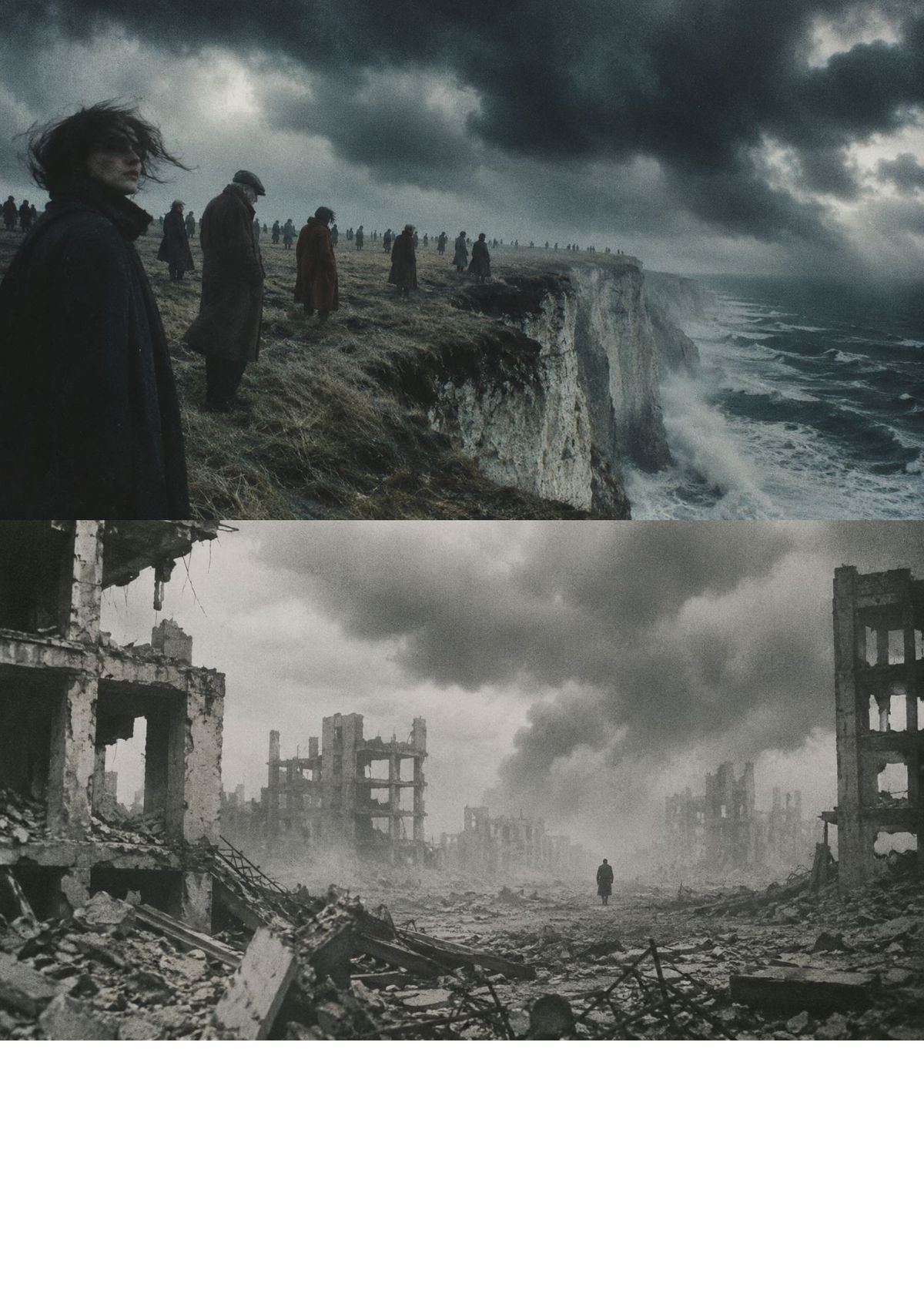
Representative imagery
Kill Committee — On the making of the album, the passing of time, and the futures we thought we'd left behind.
In 2017, Kill Committee released The Things We Nearly Saw.
The title seemed appropriate for the time. There was a growing sense that the world was approaching something uncomfortable, something familiar, but from a past we had assumed was safely behind us. The future was becoming less certain, although perhaps we hadn't quite realised how much.
For much of our lives, there had been a prevailing sense of progress. Not that the world was without conflict, injustice or suffering. Wars continued, economic inequality persisted, and the environmental consequences of our collective behaviour were becoming impossible to ignore. But there was, at least, an underlying belief that these were shared problems, demanding shared solutions.
The world appeared to be getting smaller. Borders seemed less significant. Communication, travel and technology were bringing people closer together. Communities could form across continents. Ideas could move freely. Cooperation, however imperfect, felt like the direction of travel.
It was possible to believe that the future would be more open, more tolerant, more connected than the past.
Perhaps that belief was always more fragile than we understood.
Something began to shift.
From around 2016, the political and cultural bonds that had appeared relatively secure began to fracture. Britain's relationship with Europe was torn apart. The relationship between East and West grew increasingly antagonistic. Nationalism, isolationism and political self-interest returned with renewed confidence.
The language of cooperation was gradually replaced by the language of borders, suspicion and division.
Religion, which many had assumed would occupy an increasingly private place in modern democratic societies, began asserting itself more forcefully within political life. Old certainties returned dressed as new solutions. Beliefs and ideologies that had once seemed marginal, discredited or consigned to history found themselves back in the mainstream.
What initially appeared absurd, something to be dismissed or ridiculed, became progressively harder to ignore.
It was as though the future had begun to reverse.
And over the following decade, the reversal continued.
The years between
We began writing and recording our second album almost immediately after the release of The Things We Nearly Saw.
By 2018, much of the material had already taken shape. There was no grand plan to spend the next several years making a record. We were simply continuing what we had started, following ideas, writing songs and allowing the music to find its own direction.
But the world had other plans.
A pandemic arrived. Borders closed. Cities emptied. Ordinary human contact became something to fear, regulate and avoid. The connections we had taken for granted suddenly became fragile, and isolation, once an abstract political concern, became an everyday physical reality.
For a while, everything stopped.
Then we started again.
There were further interruptions, changes in circumstances and eventually a change in the band's line-up when our drummer decided to leave. What might have marked another setback instead became an opportunity to reconsider how we wanted to work.
We established our own recording space and took responsibility for recording, engineering, mixing and producing the album ourselves.
There was freedom in that decision, but also a considerable amount of uncertainty.
Without the structure of a conventional studio schedule, the record developed at its own pace. Songs could be revisited, dismantled, reconstructed and occasionally abandoned before returning in a different form. Ideas that had begun years earlier were heard again by people whose lives, perspectives and circumstances had changed in the meantime.
The music carried traces of different moments. Some parts belonged to the world of 2018. Others could only have emerged from everything that followed.
There are undoubtedly imperfections in what we have made. We don't particularly want to disguise them.
This record is the result of the people who made it, the circumstances in which it was made, and the extraordinary amount of time that passed between its beginning and its completion.
In that sense, it is less a document of a particular moment than a collection of moments that somehow survived one another.
A death in the family
The album title emerged from this complicated landscape.
A Death in the Family.
It suggests an intimate event, something contained within the walls of a home, but its meaning extends further.
There is a death in the family of nations. In the relationships between countries that once appeared to share a common direction. In the collapse of political alliances, the erosion of trust and the abandonment of the idea that progress might be a collective endeavour.
There is a death in the family of communities, where ideology increasingly defines identity, where disagreements harden into divisions, and where belonging often demands that someone else must be excluded.
And there is a death in the family itself.
Political divisions no longer stop at national borders, or even at the front door. They find their way into conversations between friends, parents, children, brothers and sisters. Shared histories become contested territory. People who once understood one another discover that they inhabit apparently incompatible versions of reality.
The structures that connect us remain visible, but their foundations feel less certain.
Yet beneath these wider fractures lies another meaning, one that is more immediate, more personal and ultimately unavoidable.
We are a band of a certain age.
There comes a point in life when the relationship between generations begins to change. The people who once cared for us begin to need our care. The apparent permanence of our parents, something we rarely questioned when we were younger, gradually gives way to an awareness of their vulnerability.
The roles begin to reverse.
We become responsible for the people who were once responsible for us.
And somewhere within that change is the knowledge of what comes next.
It isn't necessarily a sudden realisation. More often it arrives quietly, through ordinary moments. A conversation that feels different. A task someone can no longer manage. An unfamiliar fragility in a person who once seemed indestructible.
The future begins to contain an absence.
We know what is coming, even when we cannot know when. We see the shape of the void before it exists. We understand that the loss will change the architecture of our lives, but we cannot properly imagine what that change will feel like.
There is something deeply unsettling about being able to anticipate an event that remains impossible to prepare for.
We are forced to confront the passing of time not as an abstract idea, but as something taking place in the people around us, and inevitably within ourselves.
The political and the personal begin to occupy the same space.
The disintegration of familiar structures. The loss of certainty. The recognition that things once considered permanent are not permanent at all.
Spectators and actors
Throughout these years, we have watched extraordinary events unfold.
We have watched political relationships collapse, communities divide, technology transform everyday life, and ideas we believed had been rejected return to prominence.
We have watched the language of the future change.
Where there was once a promise of greater connection, there is now an increasing sense of withdrawal. Where technology was expected to liberate people, it has also created new forms of dependency, surveillance and isolation. The same systems that allow us to communicate across the world can divide people living under the same roof.
We have become spectators of a world that feels increasingly difficult to recognise.
But spectators are never entirely removed from what they observe.
We participate in the systems we question. We inherit the assumptions we criticise. We carry the past into the present, even as we attempt to escape it.
And in our personal lives, we are not merely watching the passage of time. We are part of it.
We are children becoming carers. We are witnesses becoming participants. We are people observing the inevitable approach of loss while continuing to live, work, argue, create and make plans for a future that remains uncertain.
There is no comfortable distance from any of this.
The things we nearly saw
Looking back, the title of our first album now seems to carry an unintended significance.
The Things We Nearly Saw.
Perhaps the things we nearly saw were the futures we expected to inherit. The possibilities that seemed close enough to touch, the social and political progress we assumed would continue, the sense that history, despite its many interruptions, was moving towards something better.
Or perhaps they were the warnings we noticed but failed to understand.
The fragments of an approaching future that we dismissed because they seemed too improbable, too irrational, too much like echoes from an age we thought had ended.
Ten years later, the distinction feels less clear.
A Death in the Family is not an attempt to explain the last decade, nor does it offer a coherent solution to the problems that have emerged within it.
It is not a political manifesto or an exercise in nostalgia.
It is a collection of songs shaped by time, uncertainty, interruption and change. By the experience of watching familiar things become unfamiliar. By the strange coexistence of public upheaval and private life. By the knowledge that history does not necessarily move forward, and that personal time only moves in one direction.
The record took far longer to make than we ever intended.
Perhaps it could only have become this record by taking that long.
There are traces of who we were when we began, alongside the people we have become. There are ideas that survived unchanged and others that acquired entirely different meanings as the years passed.
Somewhere in the music is the distance between those two points.
And somewhere within that distance is the uneasy recognition that we are both spectators of what is happening and actors within it.
Watching the world change.
Watching the people around us change.
And understanding, increasingly, that we are changing too.