
Representative imagery
Nobody had called him Michael for years.
That was not entirely true, but it felt true enough to make no difference. There had been people once who used the name naturally, without hesitation, as though it belonged to him and always had. Over time those people had become fewer, then distant, then uncertain in his memory. Some were gone, some had changed beyond recognition, and some remained alive in the practical sense while belonging so completely to an earlier version of his life that contacting them would have felt like disturbing an exhibit.
He stood by the ferry window as the coastline began to appear through the morning haze. The glass was scratched and cloudy with salt. Beyond it the sea lay flat beneath a white sky, and for several minutes there seemed to be no clear division between water, air and land. Everything had blurred into one pale surface. He remembered leaving this same coast years earlier, full of the exhausted conviction that elsewhere would be different.
It had been a reasonable belief at the time. The country had become unbearable to him, not through any single event but through the daily pressure of disappointment. The conversations had soured. The television had soured. The familiar streets had begun to feel like scenes repeated long after the actors had forgotten their purpose. Everywhere people spoke of recovery, renewal and return, but the words seemed to point backwards rather than forwards. They wanted industry without smoke, community without obligation, history without guilt and a future that looked like a childhood photograph repaired by someone with no memory of the original.
He had gone to Berlin first. It had suited him for a while, mostly because it was not home and because not being at home can easily be mistaken for becoming someone new. Later there were other cities, some for work, some for love, some because moving had become easier than staying. They all offered variations on the same promise. They were modern, connected, outward-looking, alive with possibility. Yet after a few months each place revealed the same unease beneath the surface. Different people, different languages, different arguments, but the same feeling that the future had become a thing to be advertised rather than entered.
By the time he decided to return, he had stopped telling people he was coming home. Home suggested a fixed point. He was no longer sure such things existed.
As the ferry moved towards the harbour, he noticed figures standing in the shallows beyond the breakwater. At first he thought they were fishermen, though there were no rods, nets or buckets, and no sense of purpose in their stillness. Then the wind shifted and carried their voices across the water. They were singing, although not one song as far as he could tell. Snatches of old patriotic choruses rose and fell with advertising jingles, schoolyard rhymes, campaign slogans and bits of television music that had survived long after the programmes themselves had vanished. It sounded like a culture trying to remember what it had once believed.
Nobody else on the ferry appeared troubled by them. A woman nearby continued scrolling through her phone. A child pressed a packet of crisps against the window and watched the gulls. Two men in work jackets discussed the cost of replacement parts for a boiler. The singers remained waist deep in the water, staring out to sea, while the tide moved slowly around them.
Michael watched until the harbour wall hid them from view. Years earlier he might have asked someone what they were doing, but age had taught him that questions often made things less clear. Strange behaviour had become part of the background now. People adapted to it. They adapted to everything, eventually, and called it resilience because that sounded better than surrender.
The town beyond the harbour had not changed as much as he expected, which somehow made it worse. The betting shop was still there, though the name above the door had changed. The old cinema remained boarded up, its frontage covered with faded posters for films that looked recent until he noticed the dates. A charity shop had expanded into what had once been a travel agent. The bus station had been demolished and replaced by a temporary interchange that appeared to have become permanent through neglect. It was all familiar enough to reassure him and altered enough to make reassurance impossible.
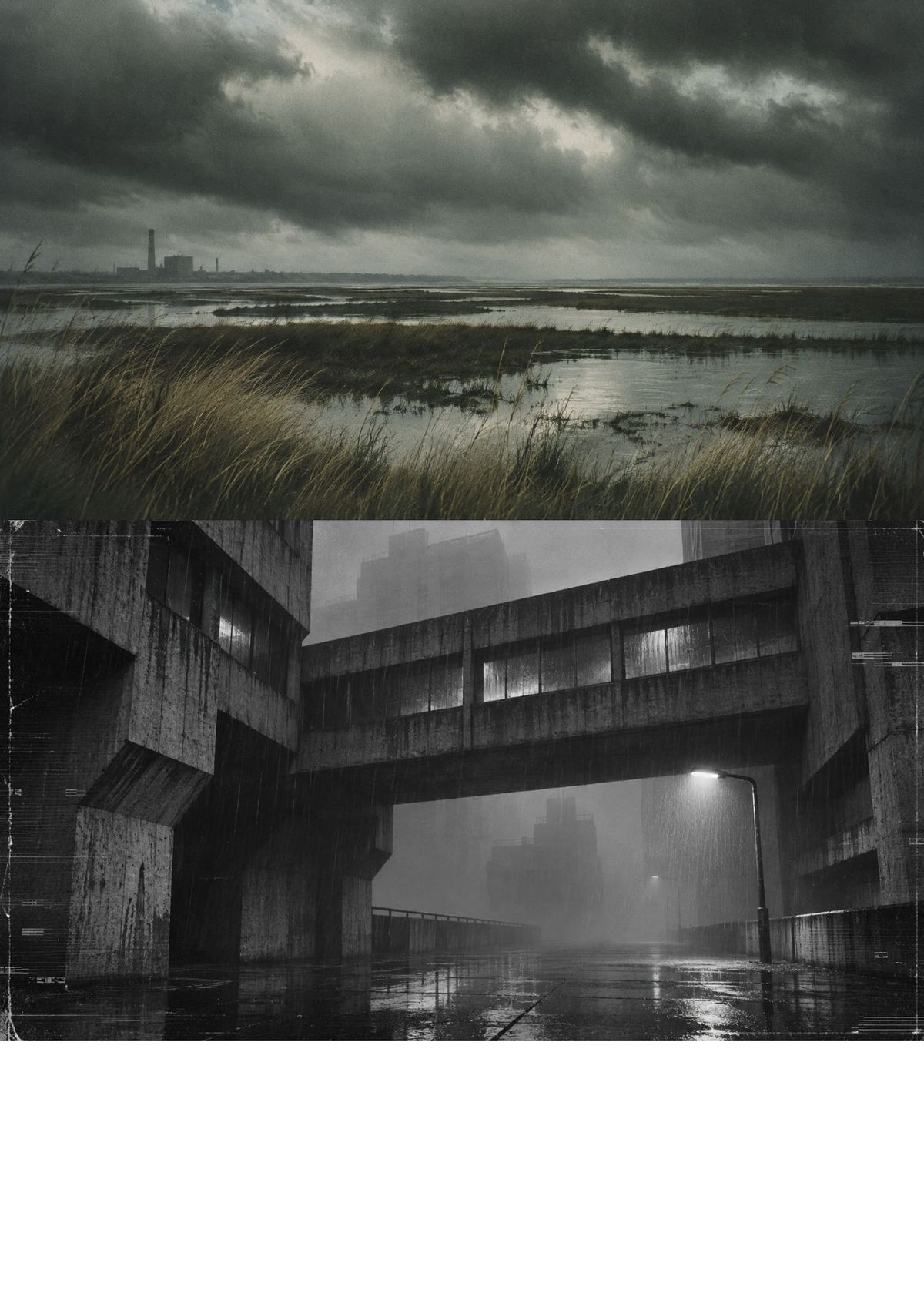
He walked rather than wait for a bus. His bag was not heavy and the road along the estuary remained one of the few routes he could have followed from memory. The marshes opened out to his left, flat and silver in the thin light. Old flood defences ran across the landscape in stern concrete lines, built to protect the future from conditions that had long since arrived and then continued arriving. Beyond them stood housing developments with optimistic names printed on signs now warped by weather.
A brown envelope skidded across the path ahead of him and lodged against a rusted fence. He stopped because the movement startled him, then picked it up with the mild caution people once reserved for official things. The paper had softened and split at one corner. Across the front, still visible in red, were the words FINAL NOTICE.
For a moment he remembered the authority such phrases once possessed. People had feared them. They had carried them into kitchens and sat beneath strip lights reading them again and again, as if a different meaning might appear through repetition. Entire evenings had been shaped by envelopes like this. Payments, appointments, penalties, assessments, warnings. There had been a time when the arrival of an official letter could alter the temperature of a house.
Now it seemed absurd.
Not the letter itself, exactly, but the seriousness with which everyone had once received such things. The confidence that somewhere there was a department, and behind that department a system, and behind the system some final adult presence capable of arranging the world into categories, deadlines and consequences. The offices that produced the letter were probably gone, or renamed, or folded into something private and unreachable. The telephone numbers would no longer connect. The websites would have expired. The people addressed were perhaps dead, or moved away, or still waiting for instructions that had lost all power to arrive.
He let the envelope go and watched the wind carry it into the reeds. It moved with a kind of comic dignity, like a small surviving official refusing to accept that the country it served had dissolved around it.
Further along the path, the birds rose from the marshes.
There were thousands of them, black against the pale sky, moving with a coordination that made the individual birds disappear into a single shifting form. Michael stopped walking. The murmuration widened, folded, narrowed and expanded again, and as he watched he found himself thinking of a net. It was not a rational comparison, but once it occurred to him he could not shake it. The flock seemed less like a collection of creatures than a vast dark net being drawn across the land.
It swept low over the marshes and turned towards the sea. For several seconds he felt, with an intensity he could not explain, that it was gathering something as it moved. Not fish or insects or any visible thing. Something lighter and older. The remaining scraps of hope perhaps, or the small stubborn expectation that life would eventually explain itself if one kept going long enough. The birds banked sharply and drifted out over the water, carrying whatever he had imagined away with them.
He stood for a long time after they had gone.
The thought of her came then, as it often did when he found himself near water. He had become less able to remember what she looked like, and this failure no longer shocked him as it once had. Faces were unstable things. They changed even when present, so memory could hardly be blamed for altering them in absence. What remained was not her face but the effect of her. She had possessed a way of making the world feel less crowded. While other people added noise, she somehow removed it. Around her, confusion remained confusion, but it became something one could sit with rather than flee.
He had never known whether he loved her or whether she had merely arrived at a time when he needed peace badly enough to mistake it for love. The distinction had seemed important once. Now it felt like another official category whose authority had expired.
By late afternoon the light had begun to drain from the marshes. The first distant lamps appeared among the units, estates and empty service roads that had spread across the estuary during his absence. Somewhere beyond them lay the streets where he had grown up, although grown up seemed a strange phrase now. He had not grown upwards, only further away from the version of himself that once believed adulthood would involve a gradual increase in understanding.
The singers in the sea were no longer visible, but occasionally the wind carried something that might have been their voices. He could not make out the words. Perhaps there were no words anymore. Perhaps that was the point.
He continued walking as the tide came in.