
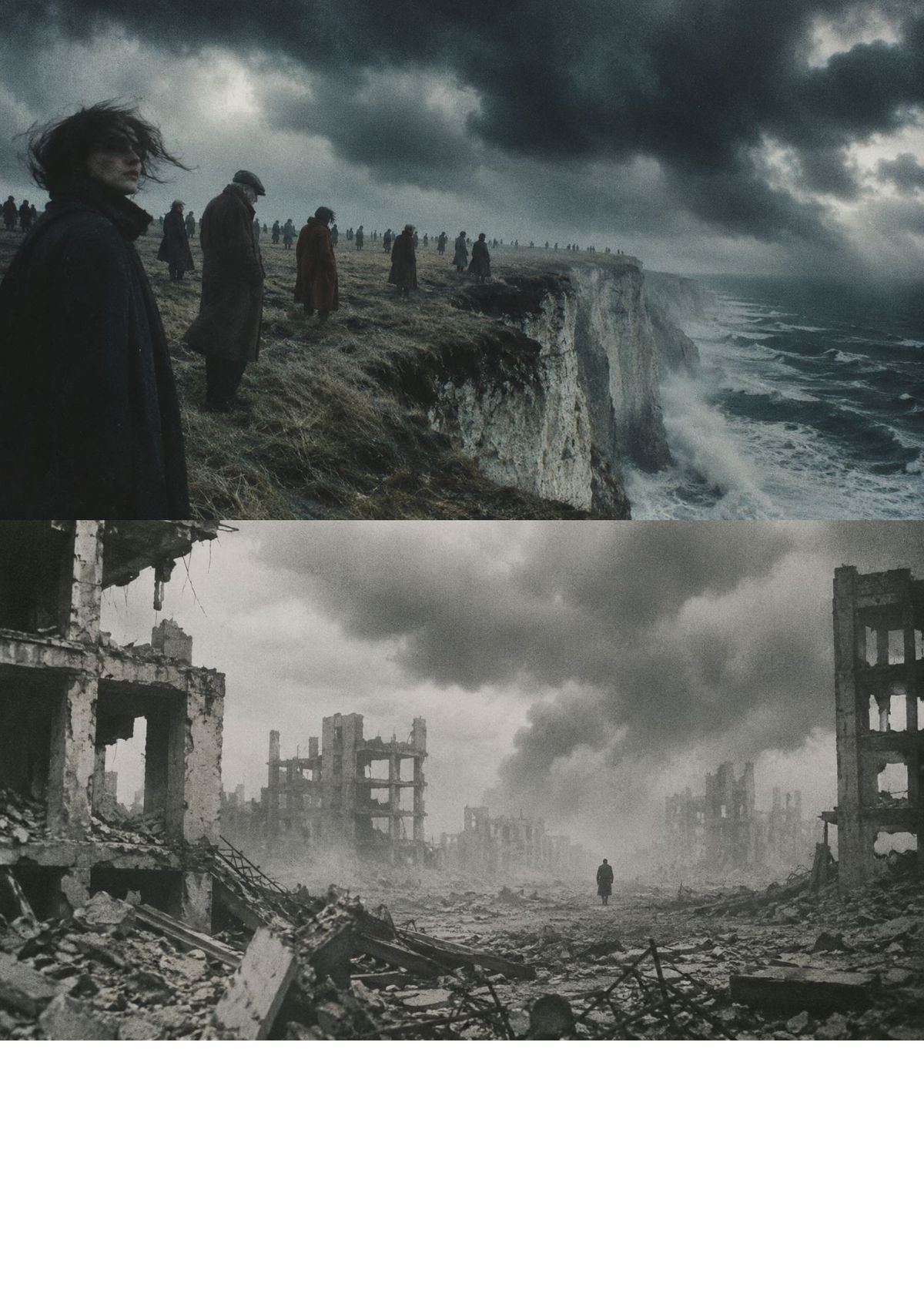
Representative imagery
The nightclub had closed years before Michael left, yet people still referred to it as though it were part of the town’s active geography. Directions were given in relation to it. Stories began there. Arguments from twenty or thirty years earlier still found their way back to its doorway, its sticky carpets, its toilets, its cheap mirrors and its staircase that everyone remembered as dangerous but nobody remembered repairing.
The building remained at the edge of a service road near the retail park. Its sign had been removed, leaving a pale rectangle on the brickwork where the name had once been. Metal shutters covered the lower windows. The upper ones had been broken and boarded from within, although one sheet of plywood had come loose and moved slightly whenever the wind caught it. The place had the look of a body nobody had collected because everyone assumed someone else was dealing with it.
Michael had not intended to go there. He had taken the wrong road after leaving the marshes and recognised the area only when he saw the supermarket lights on the horizon. The shops around it had changed repeatedly over the years, but the layout remained fixed in him with the strange authority of teenage memory. Here was where the taxis used to wait. There was the alley where people smoked, argued, kissed or cried depending on the hour. Beyond the loading bays was the patch of waste ground where someone had once set fire to a mattress and everyone had watched as though it were entertainment organised for them.
He stopped outside the old entrance.
For a moment he could almost hear it. Not music exactly, but the pressure of music through walls. Bass, glass, shouting, bells from fruit machines, laughter too loud to be sincere. The particular tinnitus of youth. His generation had carried that sound into middle age without realising it. Even now, in quiet rooms, he sometimes heard a high electric ringing that seemed less like damage to his hearing than a signal from a former life.
Someone had painted THE FUTURE’S NOW across the boarded doorway in silver letters. Beneath it, in smaller black paint, another hand had added, THEN IT’LL STILL BE NOW TOMORROW.
The joke had weathered better than the slogan.
He remembered the phrase from somewhere. A school assembly perhaps, or a careers video shown on a wheeled television while a teacher struggled with the tracking. The future was always being announced back then. It arrived in magazines, in children’s science books, in glossy pull-outs from Sunday papers. There would be colonies on other planets, robot assistants, clean energy, intelligent homes and machines that liberated everyone from drudgery. Even the cheapness of the images had made them feel possible. Silver jumpsuits, monorails, video phones and smiling families stepping into the next century with perfect teeth.
They had received some of it, technically.
The video phones arrived and made everyone lonelier. The intelligent homes listened and broke down. The machines did not liberate people from work so much as follow them into every waking hour. Billionaires played astronauts while pavements cracked outside food banks. The future had come, but not as land. More like weather. Something to endure.
He crossed the service road and looked through the dusty window of the furniture showroom opposite. It too had closed, though more recently. Inside, under a collapsed strip of ceiling tile, stood a sofa facing the glass. It was grey, square and anonymous, the sort of thing designed to offend nobody and comfort no one for long. A sun-bleached price tag still hung from one arm.
The sight disturbed him more than the nightclub.
Perhaps because a sofa suggested waiting. It belonged to evenings, to television light, to tired bodies resting at the end of ordinary days. This one faced the abandoned road as though expecting a family to arrive, sit down and resume a life interrupted only briefly. Michael imagined people sitting there years ago, testing its cushions, discussing measurements, deciding whether it would fit through a hallway. Small domestic hopes, treated at the time as practical decisions.
He thought again of official letters moving through the reeds.
Final notices.
Delivery windows.
Insurance documents.
Instructions for lives that had assumed continuity.
The sofa, the nightclub and the envelope seemed to belong to the same ruined system of belief. They were not dramatic enough to be monuments, but they had outlived the meanings that produced them. This, he thought, was what people failed to understand about loss. It did not arrive only as grief. Sometimes it arrived as furniture in the wrong place.
As evening settled, the retail park lights came on automatically. A few cars moved between the drive-through restaurant and the supermarket. Nobody looked towards the nightclub. That too seemed important. The past had not been buried. It had been left in plain sight until people stopped seeing it.
There had been stories about the club, of course. Every town had them. Grubby stories. Half-remembered and eagerly repeated. Men who should have known better. Girls who were too young. Money missing. Police called too late or not at all. A death in the toilets that some said had happened and others insisted had been exaggerated from something else. Michael had never known the truth. When he was younger, uncertainty had annoyed him. Now he understood that truth often mattered less than the shape a story left behind.
He had enjoyed it there sometimes. That was the awkward thing. Memory preferred clean divisions and rarely provided them. He remembered bad music and worse lager, but also moments of intense, stupid happiness. Friends leaning into each other because the volume made speech impossible. Someone’s hand finding his in the dark. The sudden belief, at two in the morning, that life was about to begin properly. He remembered trying to look older, then spending the rest of his life trying to feel younger. He remembered desire as pursuit, embarrassment, theatre and occasional kindness. He remembered wanting to be seen and fearing what might happen if he was.
Across the road, the sofa waited.
The stars appeared gradually above the retail units. They looked exactly as they had in childhood, which seemed both comforting and cruel. People had invested so much hope in them. Not spiritually, not exactly, but culturally. The stars had been the backdrop to rescue. Spacecraft, signals, other civilisations, cosmic perspectives that would make human stupidity small enough to survive. As a boy, Michael had stared at television screens full of cardboard planets and studio fog and believed that imagination itself might lead somewhere.
The stars remained.
Everything beneath them had altered.
He wondered whether children still looked upwards and felt promised anything. Perhaps they knew better. Perhaps the cruelty of his generation had been to inherit optimism cheaply and then discover too late that it required maintenance.
A movement inside the nightclub caught his eye.
He turned back towards the broken upper window. Something shifted behind the loose board, or seemed to. A face, perhaps, although the light was poor and the glass reflected the supermarket sign behind him. He stood watching for several minutes. Nothing moved again.
In the past he would have dismissed it as a trick of light.
He was less certain now.
Not because he believed in ghosts, but because the word ghost had become too narrow. It suggested the dead returning, when what troubled him was the persistence of things that had never properly left. Old rooms. Old music. Old versions of the self, still leaning at bars, still making mistakes, still waiting for some future announcement that never came.
He thought of her again, not as she had been but as one of the few people who had ever made silence feel safe. There had been evenings when he left places like this and walked with her through empty streets while the sky changed colour. She had not saved him. He disliked the arrogance of that idea. People were not rescue vessels. Yet something in her presence had allowed him to become less frantic, and the memory of that calm now seemed more precious than any declaration he might once have wanted from her.
From somewhere beyond the retail park came the faint sound of singing. The same sea voices, or others like them. The words were indistinct, but the rhythm was familiar enough to be inherited. It rose and fell across the car parks and service roads, passing through metal fences and dead signage as if looking for a mouth to occupy.
Michael remained outside the nightclub until the automatic lights began switching off one by one.
Just before he turned to leave, he looked again at the upstairs window. For a moment he saw his own reflection in the dark glass, older than expected, watching himself from inside the place he thought he had left behind.
That was all.
That was enough.